
Kanabec County Arrest Warrants Explained
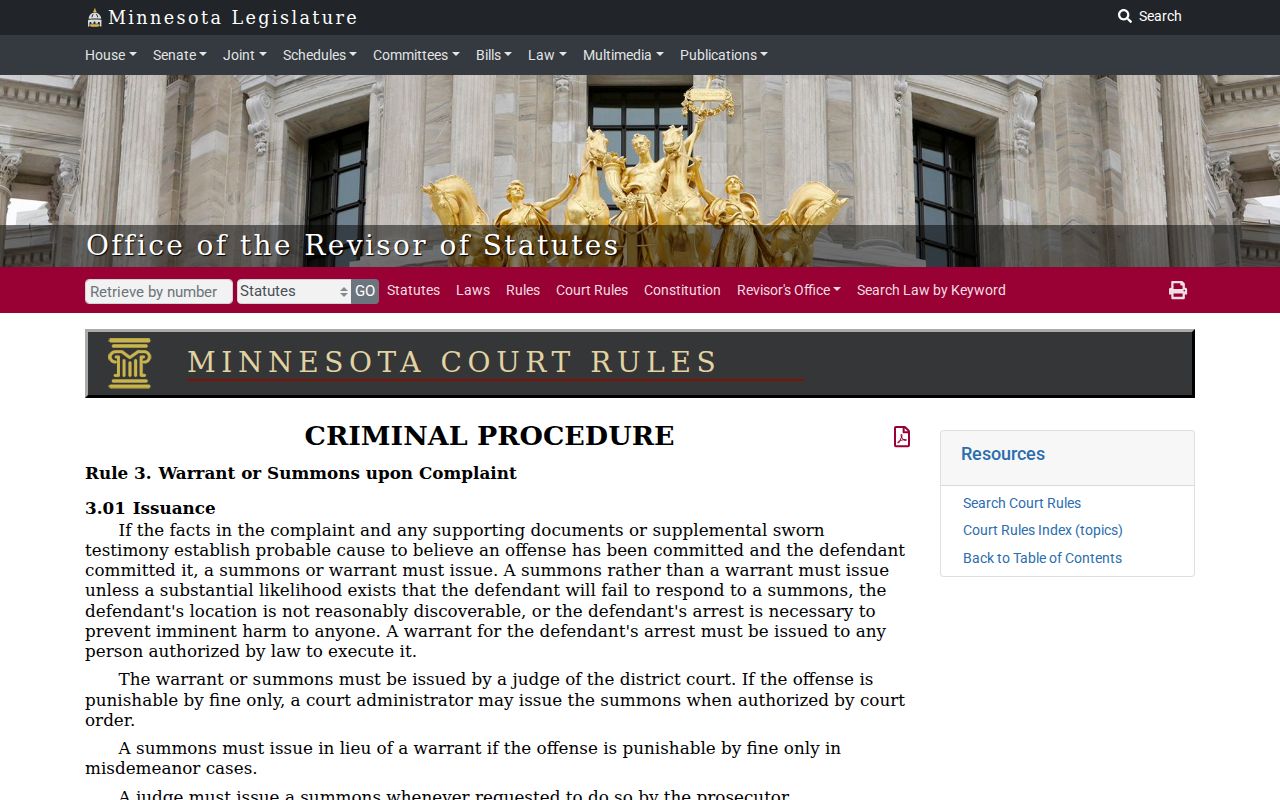
Before any Minnesota judge signs an arrest warrant, someone has to show probable cause. That showing lives in a complaint. The complaint names the offense and lays out the facts behind it. A judge reads it and decides. In Kanabec County the next step is plain: the District Court issues arrest warrants and forwards them to the Sheriff for enforcement. Rule 3 does not make warrants the default, though. The court is supposed to prefer a summons unless the person is unlikely to respond, cannot be located, or must be arrested right away to prevent imminent harm. That preference trips people up. A serious charge can arrive with no warrant at all, just a summons. And when a Kanabec County warrant does issue, it carries weight, because a judge found that one of those exceptions fit.
Kanabec Arrest Warrant Probable Cause
Probable cause is about the facts, not the person. It asks whether the complaint gives a reasonable basis to believe the offense happened and that this particular person was involved. Kanabec County judges work from the complaint, the charging document the whole warrant rests on. The warrant has requirements too. Rule 3 lists them. The judge's signature goes on it. It must also name the defendant or give a description, state the offense, and list the bail amount and any conditions.
Two practical points about a Kanabec County warrant. A warrant with no stated bail amount is not an error, since a judge can order release on conditions instead of money. And the case remains a case. The charge still has to be answered, and a defendant keeps the right to a defense and to counsel.
Key rule: Rule 3 governs complaints, summonses, and warrants, including what a warrant must contain and how it is executed.
Inside a Kanabec County Arrest Warrant
The paper itself is brief. A Kanabec County arrest warrant identifies the case, the person, and the court's authority, then hands the enforcement job to law enforcement.
| Court and District | Kanabec District Court, Tenth Judicial District |
|---|---|
| Case File Number | Minnesota combines county, case type, year, and sequence, as in 33-CR-25-418 |
| Defendant | Name or a description when the name is unknown |
| Offense | The charge stated in the complaint |
| Bail and Conditions | Amount and release terms the judge set, where any were set |
| Issuing Authority | The judge's signature and the date of issuance |
| Appearance Language | The direction to bring the person before the court promptly |
A bond figure on a Kanabec County warrant is a starting point, not a price list. The judge can set conditions instead of money. Rule 6 leans toward a personal-recognizance or unsecured bond whenever release is ordered.
The Kanabec Warrant 36-Hour Rule
The clock after a Minnesota arrest is short. A warrant directs that the person be brought before the court promptly. The outer limit is 36 hours after the arrest, not counting the day of the arrest. Court not in session? The appearance follows once a judge is free. That is why a weekend arrest still produces a fast court appearance in Kanabec County. It is also why the first hours matter for a family trying to reach an attorney. Release conditions get set at the initial appearance. Preparing before it beats preparing after. Someone picked up on a Kanabec County warrant should be told the charge and that a warrant exists. The officer need not hold the paper at the stop.
Serving Arrest Warrants in Kanabec County
A Minnesota warrant runs statewide. Rule 3.03 lets an authorized officer execute it anywhere in the state. The officer does not need the paper in hand. Notice of the warrant and the charge is enough. So a Kanabec County warrant can surface at a traffic stop, at a courthouse, or at your front door. The Kanabec County Sheriff's Office takes the warrants the District Court forwards into its own system. Patrol and investigations divisions then handle the hunt. A deputy assigned to find someone counts as execution too.
Kanabec County Sheriff's Office
Warrant questions and enforcement status
320-679-8400
Kanabec County describes no separate warrant unit. Questions about service go to the main warrant line. Dispatch and the jail answer around the clock, while administration keeps Monday through Friday hours, 8:00 a.m. to 4:00 p.m.
What a Kanabec Warrant Does Not Prove
An arrest warrant is a court's decision that process should issue, and that is all it is. The real limits sit elsewhere. A jail booking record can look like proof of an active warrant in Kanabec County. Often it just reflects custody on some other matter. A search hit is not the same as a live arrest authorization either. Warrants get recalled, served, and superseded. A public list publishes only once a day, so an entry can lag behind what the court has already done. That is why a warrant question ends with a phone call, not a search box. The issuing court can confirm what is active. So can the Kanabec County sheriff.
Comparing Arrest, Summons, and Bench Warrants
Minnesota courts reach for three tools when they need someone in court. One starts a case with cuffs. Another opens a case by summons. The third, a bench warrant, goes after someone whose case is already open in Kanabec County but who stopped showing up.
| Instrument | When the court uses it | What it orders |
|---|---|---|
| Summons | The preferred route when a person is likely to appear | Appear in court on a set date |
| Arrest warrant | Nonresponse likely, location unknown, or imminent harm | Take the person into custody and bring them before the court |
| Bench warrant | A missed appearance or a violated order in an open case | Bring the person back into the case that already exists |
A fourth tool behaves differently. A sign-and-release warrant skips the arrest. It carries a new appearance date instead. The bench warrant search page compares all four in more depth, a useful stop for anyone in Kanabec County weighing a bench warrant.
Kanabec Warrant Probation Orders
Not every warrant in Kanabec County starts with a criminal complaint. Probation officers issue their own arrest and detention orders. The county says those land in the sheriff's warrant system beside court warrants. Child support runs on a separate track. That office uses bench warrants plus arrest or commitment orders. A county board packet lays out the work behind them. It lists due diligence, criminal-history checks, coordination with agencies outside Kanabec County, and transport. So who confirms the order depends on its source. For a criminal warrant, ask the District Court or the sheriff; for a probation matter, the supervising office; for support, the child-support office.
If There's an Arrest Warrant for You
Sequence beats speed here. Confirm the warrant first, including its type. Then get advice before anything irreversible happens. In Kanabec County, start with the sheriff's warrant line at 320-679-8400 to learn which agency holds the record. Follow with Court Administration at 320-679-6400 to hear what the file shows and when a next appearance could be set.
Important: Speak with an attorney before turning yourself in. An active arrest warrant can be executed at any traffic stop, and Kanabec County publishes no walk-in warrant desk or after-hours clearance process.
- Confirm the process type and the agency that controls it, and note the date.
- Give the case number and the charges to an attorney before making a plan.
- Ask what appearance date is available and whether release conditions can be set then.
- Prepare identification, plus any record that explains a missed date.
- Follow the plan your attorney agrees with the court, and keep every appointment.
When a Kanabec Warrant Listing Looks Stale
A listing can outlive the facts behind it. Last week's entry may describe a warrant already served. An older one may sit under a case that resolved another way. A better Kanabec County warrant search will not fix that. Confirmation with a date will. Ask the sheriff's office whether the entry is current. Ask the court whether anything in the file superseded it. If the two disagree, ask which record controls. Get that answer in writing if you can. Federal matters sit outside this whole system. A warrant from the U.S. District Court for the District of Minnesota is no Kanabec County record, and a clean local search says nothing about it; federal dockets run through PACER, and the U.S. Marshals Service handles enforcement.