
Kanabec County Bench Warrants Explained
Kanabec County explains its court warrants in plain terms, and the explanation covers more than missed hearings. Most are issued when someone fails to respond to the court or fails to carry out an order the court made. That is the working definition of a bench warrant here. Minnesota's rules follow the same idea. Missing a court date on a summons can produce a warrant. The statewide sample form is even titled as an application to obtain a defendant's appearance after a failure to appear in response to a summons or citation. Three triggers account for most bench warrants. A missed court date comes first. An unpaid obligation the court ordered comes second. A violated release condition comes third. In every case the warrant is process that moves a case forward, not punishment for it.
Kanabec Bench Warrant Form 8
Minnesota publishes a sample form for this exact situation. Form 8 is the application and warrant used to obtain a defendant's appearance after a failure to appear in response to a summons or citation, and it shows what the paperwork behind a Kanabec County bench warrant actually contains. The statewide form is not a local record, but its structure is the structure used around the state, Kanabec County included. The header carries the county and judicial district. Below that sit the parties, the district court file number, and the prosecutor's signature block. The body holds the probable-cause statement, the charged offense, the appearance language, any release conditions, a bail amount, and the issuing officer's signature.
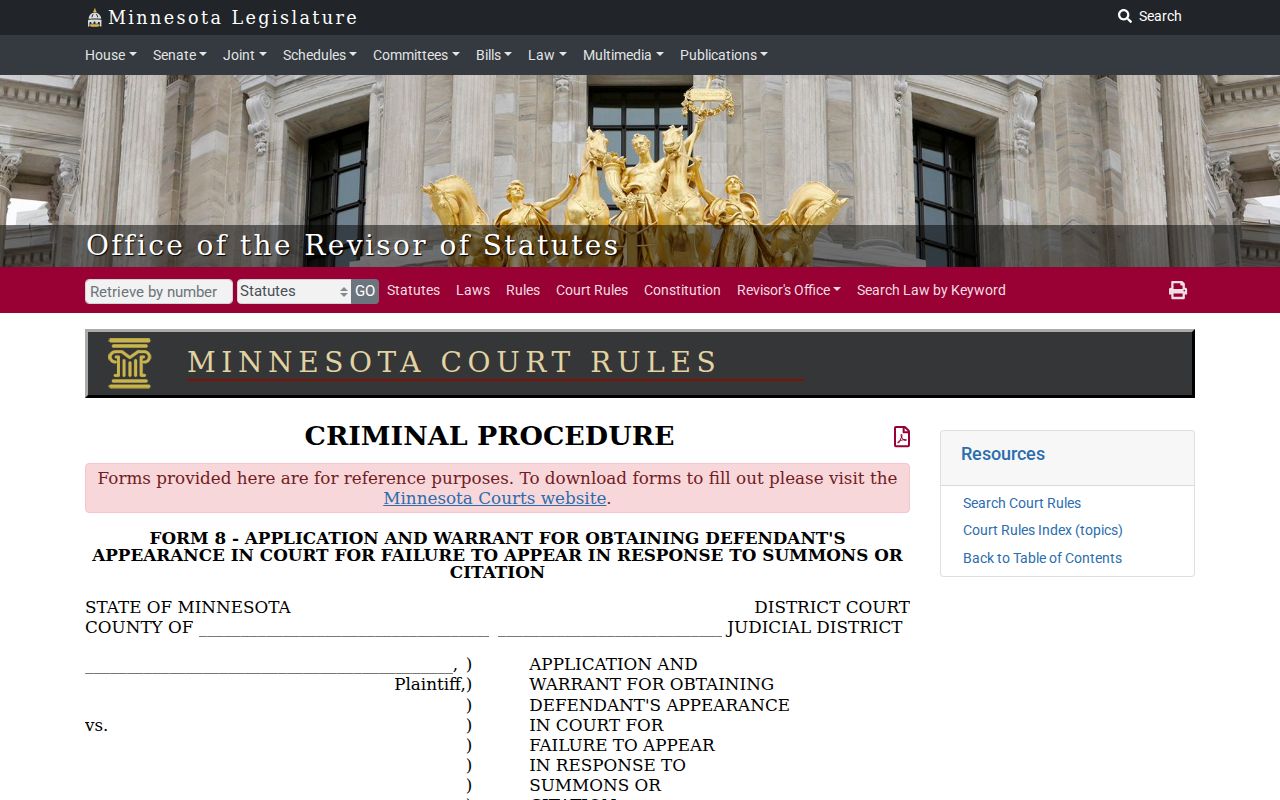
Reading that blank form pays off before you call. It shows which details Court Administration will ask for. Expect questions about the case number, the missed event, and the current appearance status. Note: A blank statewide form explains the process, and it is not a record of any Kanabec County case.
How Kanabec County Bench Warrants Are Issued
A judge issues the warrant inside a case that is already open. No new charge is filed and no new complaint is drawn up. The court notes the missed obligation, applies the rule that governs it, and directs law enforcement to bring the person in. The paperwork then travels a short path in Kanabec County. The clerk files it in the case, the sheriff receives the enforcement copy, and the entry lands in the database that publishes each night. Release violations run a slightly different route. Rule 6.03 prefers a summons for those unless there is a substantial likelihood of nonresponse, a danger of further crime, or a location that cannot be found.
Missed a Kanabec Warrant Court Date
Missed dates have ordinary causes. A notice arrived late. A ride fell through. Someone got sick, could not cover a shift, or believed the hearing was remote. Waiting resolves none of it, though, because the warrant stays active until the court acts. The useful sequence in Kanabec County is short and specific.
- Look up the case in the public court search with Kanabec County selected, and write down the missed event and the case number.
- Call Court Administration at 320-679-6400 and explain what happened, then ask for the next available appearance.
- Ask whether a bench warrant has been issued and who controls its status.
- Talk with an attorney about appearing, requesting a new date, or asking the court to recall the warrant.
- Call the sheriff's warrant line at 320-679-8400 if you need to confirm enforcement status before you travel.
Minnesota's criminal help materials point the same way. Contact your attorney or the Kanabec County court if you cannot appear.
Bench Warrants and Arrest Warrants Compared
On a list, the two look the same. In practice they behave differently. An arrest warrant starts a case, while a bench warrant follows a Kanabec County case that already exists, and that difference shapes how each one gets resolved.
| Point | Bench warrant | Arrest warrant |
|---|---|---|
| What it follows | A missed appearance or a violated order | A complaint supported by probable cause |
| Where it lives | In the case file that already exists | In a new case file |
| Who controls it | The judge in that case | The judge who issued it |
| Typical resolution | New appearance, recall, or bail | Appearance, bail, or recall |
One practical reason keeps the comparison worth knowing. A bench warrant cannot be fixed by paying a fine, and an unpaid obligation cannot be fixed by ignoring the warrant. Either way, only the Kanabec County court that issued the warrant can resolve it.
What a Kanabec Bench Warrant Is Not
A bench warrant is a court's instruction to bring a person before the judge in a case already pending. The underlying charge still has to be proven, dismissed, or resolved on its own terms. It is also not the same as a jail booking. A custody record shows someone is in the building today. A warrant record shows process exists, nothing more. Most bench warrants in a county like Kanabec grow out of missed dates, changed addresses, and unpaid obligations rather than anything dramatic.
Resolving a Kanabec County Bench Warrant
Resolution starts with the court that issued the warrant. Kanabec County publishes no recall form, runs no walk-in warrant counter, and offers no self-service way to lift a bench warrant. The path runs through the clerk, the judge, and usually an attorney.
Before you travel: Call 320-679-6400 and ask whether a warrant is active, what type it is, and whether a new appearance can be scheduled. Kanabec County publishes no after-hours warrant desk.
Someone facing a Kanabec County bench warrant has four ways forward. A new court date answers the missed appearance. A voluntary appearance works if the court confirms it. Posting bail settles the release question. A motion to recall or quash asks the judge to withdraw the process outright. That route calls for a lawyer. Two cautions apply here. Paying a fine can resolve a citation while leaving a separate warrant untouched, since payment in Minnesota courts carries a guilty-plea and waiver warning. A call to the sheriff confirms status. Only the court can change it.
Kanabec County Sign-and-Release Warrants
One Minnesota process looks like a bench warrant but behaves nothing like one. Under Minnesota Statutes 629.415, a sign-and-release warrant covers certain failure-to-appear situations. It authorizes no arrest. It requires no bail. The officer simply tells the person about the missed hearing and the new appearance time, releases them at the scene, inactivates the warrant, and files notice of what happened under that statute. The Kanabec County court gets its appearance date without an arrest.
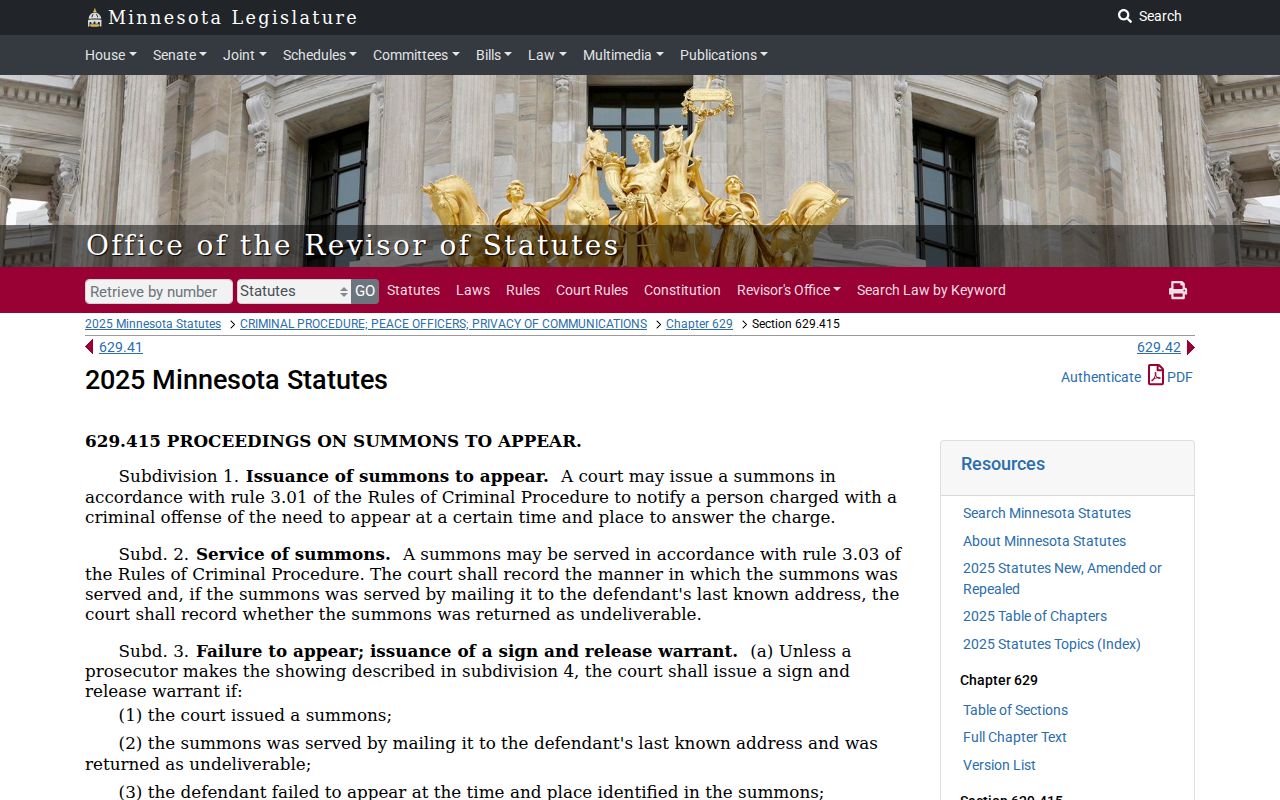
So make type your first question, not status. Ask whether a Kanabec County warrant is sign-and-release or a true bench warrant. Someone who assumes every warrant means jail may take a far harder step than the court intended.
Key point: Ask whether the process is sign-and-release before making any plan, because that warrant type carries a new appearance date rather than an arrest.
Finding the Court That Issued the Warrant
In Kanabec County, the issuing court is almost always Kanabec District Court in the Tenth Judicial District. Minnesota puts criminal and traffic cases filed in the county before the district court. There is no separate municipal or justice-of-the-peace criminal court. That makes the search simpler. A bench warrant from a Kanabec County case is controlled by the judge in that case. The file itself sits with Court Administration at the courthouse on Maple Avenue East in Mora.
Kanabec County Court Administration
317 Maple Avenue East, Suite 318
Mora, MN 55051
320-679-6400
A specialized order changes the routing, not the court. Probation arrest orders and child-support enforcement matters also run through the district court, and Kanabec County child-support enforcement work is handled with the sheriff's office. If a case involves probation or support, ask that office to confirm the order too.
Kanabec Warrant Release Violations
Two event paths lead to a Kanabec County bench warrant. They are not the same event. A failure to appear means a required court date was missed. A release violation means a condition the court set was broken, such as a no-contact term or a check-in requirement. Rule 6 governs release and conditions, and it governs what follows a violation. When a violation is alleged, the court can issue a summons or a warrant. The rule prefers a summons unless nonresponse is likely, further crime is a danger, or the person cannot be found. The distinction matters for the record you ask about. A failure to appear shows in the case events. A release violation may carry a separate hearing and added conditions. Before assuming the fix is a new date, ask Court Administration which event the Kanabec County warrant is tied to.